From OLTP to OLAP: How Data Moves from 3NF to a Dimensional Data Warehouse
Modern data architectures typically separate operational systems from analytical systems. This separation is not accidental—it reflects fundamentally different workloads, data models, and optimization strategies.
This article explains the conceptual transition:
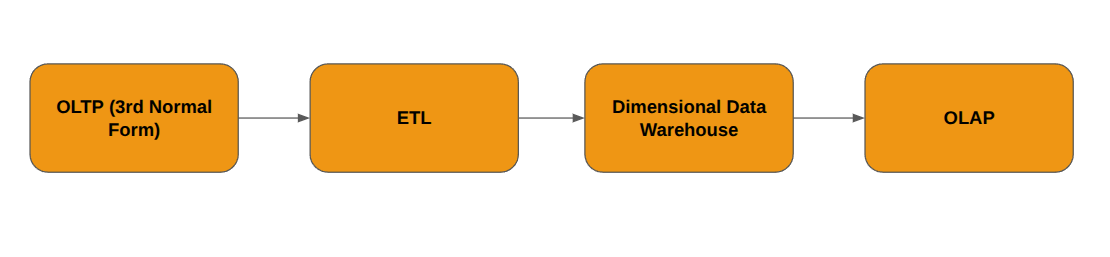
Operational Systems (OLTP) and 3rd Normal Form
Transactional systems—CRM platforms, payment processors, ERPs, application databases—are designed for:
- High write throughput
- Concurrency
- Referential integrity
- Low-latency lookups
These systems are usually modeled in Third Normal Form (3NF).
Why 3NF?
3NF minimizes redundancy and enforces data integrity by:
- Eliminating repeating groups
- Removing partial dependencies
- Removing transitive dependencies
The result is a highly normalized schema with many related tables.
orders
order_items
customers
products
addresses
payments
This structure is ideal for transactional consistency but inefficient for analytical queries requiring joins across many tables.
The Problem: OLTP Is Not Designed for Analytics
Analytical queries typically require:
- Aggregations (SUM, COUNT, AVG)
- Time-based grouping
- Historical comparisons
- Large table scans
Executing these directly on OLTP systems:
- Impacts production performance
- Increases locking contention
- Produces complex, multi-join queries
- Does not scale efficiently for BI workloads
This is where the analytical layer becomes necessary.
ETL: Extract, Transform, Load
The ETL layer bridges operational systems and the data warehouse.
Extract
Data is pulled from OLTP systems (A, B, C).
Transform
This is the critical step:
- Data cleansing
- Type normalization
- Business rule application
- Surrogate key generation
- Denormalization
- Fact/dimension separation
Load
Transformed data is loaded into the Data Warehouse.
Modern stacks may use ELT (transform inside the warehouse), but the conceptual flow remains the same.
From 3NF to Dimensional Modeling
The major structural shift occurs here:
Normalized relational schema → Dimensional model
Dimensional modeling (popularized by Ralph Kimball) reorganizes data into:
- Fact tables (measurable events)
- Dimension tables (descriptive attributes)
Star Schema Example
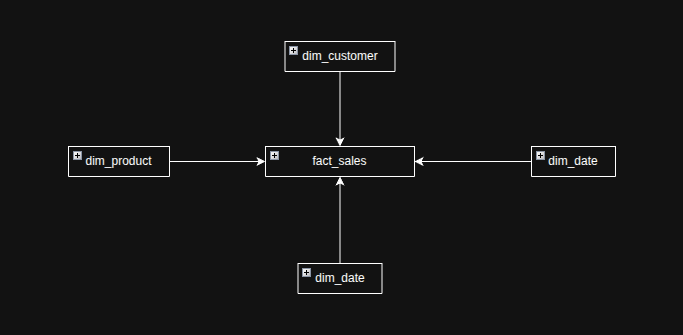
This structure:
- Reduces join complexity
- Optimizes aggregation queries
- Improves query performance
- Simplifies BI consumption
The dimensional model is not more “correct” than 3NF. It is optimized for analytical workloads.
Data Warehouse Characteristics
A properly designed Data Warehouse is:
- Subject-oriented
- Integrated
- Time-variant
- Non-volatile
It is built for historical analysis and decision support—not transactions.
OLAP: Analytical Consumption
Once data is modeled dimensionally, it supports:
- BI dashboards
- Executive reporting
- Financial modeling
- KPI monitoring
- Ad hoc analysis
OLAP workloads emphasize:
- Read-heavy access
- Aggregations over large datasets
- Columnar storage efficiency
- Partition pruning
- Materialized views (optional)